Sunday, February 20, 2022

finally putting my photography skills to the test

 Lighting is a very important part of film production yet its rarely talked about or given any importance. Any scene's mood and tone can be set through lighting schemes. One misbelief I had is that I needed a very good camera to produce a good quality film and that is not the case.
"A film shot on a cheap DSLR can look excellent with good, well-thought-out lighting. A film shot on an expensive camera will look like amateurish garbage with poor lighting."  -Nick Larovere

The key steps in the lighting process are:

  • Identify the requirements
  • Determine the method of lighting
  • Select the lighting equipment
  • Calculate the lighting parameter and adjust the design as required
(Disclaimer: yes I know that website is not about production lighting but they have good tips for lighting regardless and here is what I gathered from it) 
Breaking down these steps from Electrical Engineering Portal, they basically say that you need a plan before jumping into picking what lighting products you're gonna use. First steps say determining what you will need for the scene you are recording. Consider what tone you want the scene to set. Will it need high-key lighting or low-key lighting?
After realizing that you can select the lighting equipment you're gonna use, and it does not need to be the fanciest lights you could afford, any equipment available to you can be used and produce a good quality film if you know how to. You must learn how to opperate the equipment obviously, and also consider using different colored lights to set tone, and that can be done by something as simple as placing a colored sheet over the lighting equipment you're using.

Why is lighting important?

  • Lighting tells the audience where to look. The lighting setup guides the eye to a specific actor, prop, or part of a scene.

  • Lighting reflects the psychology of characters. The amount, size, color, and harshness of light surrounding a character can be adjusted to match their emotions.

  • Lighting defines and supports the genre of the film. Lighting is the tool that conveys mood most clearly. For example, one of the film genres most known for its distinct lighting style is film noir, characterized by stark contrasts between light and dark, dramatically patterned shadows, and unique framing and composition choices.

Since my scene will be shot at a dark room with the only light coming from the character's phone screen, I researched how to film a scene in a dark room. One good thing about this is that the focus of the scene will be on the character's face, which is ideal. 
Here are things I will need to consider:
  • Arranging the lighting in a frame
  • Adjusting the white balance
  • Beware of casting shadows
  • Focus/brightness 
  • Consistency is always key
  • Find props that are already at the location
Fortunately I took creative photo last year at Cypress and I remember all the different tips and tricks for Iphone's camera settings, and will be using that to my advantage. For example, since the rest of the room will be dark but the phone I can set the focus of the camera on the outside to make it darker and turn the brightness down and if needed I will research more tips for filming with an Iphone. 

Sources: 


Thursday, February 17, 2022

why is representation important?

 "Representation is how media texts deal with and present gender, age, ethnicity, national and regional identity, social issues, and events to an audience. Media texts have the power to shape an audience's knowledge and understanding of these important topics." GCSE Media Studies Revision - BBC

Basically, representation is the way that media creators CHOOSE to portray reality or aspects of reality. It usually includes: race (biology/ethnicity), communities, gender, sexuality, and events (representing society in a "prettier" way.)

What impacts these choices?

-Ownership: companies have a lot of power when choosing what they want to be portrayed in media, and each company will represent different topics in different ways. 

-Creator bias: anyone creating any content will be biased towards it because they have their own opinions on the subject, and that is what happens to many media produced by these companies.

-Governing factions: the government of different countries has different laws that enable them to restrict media from being allowed in their territory. For example, Russia has laws against expressing sexuality and restricts every form of media that portrays the LGBTQ+ community. 

-Majority rule: at the end of the day, these companies will produce and distribute media that they know will attract the audience, they want success as a lot of these companies care more about money and company growth, unfortunately. 

Historically, many groups have been underrepresented in western media, and those are LBGTQ+, people of color, range of body sizes/types, people with disabilities (big one!!!), people with mental illness (my topic!!!), and the elderly. 

Additionally, more so in the past than now, a lot of media makes use of stereotypical roles for characters in their pieces. 
"These are a simplified representation of a person, groups of people, or a place, through basic or obvious characteristics - which are often exaggerated. They can be used to describe characters quickly, relying on existing audience recognition. Stereotypes are dangerous as they can lead audiences to generalize about people or places."

"
Stereotypes in media are often inaccurate and portray underrepresented groups in a negative light."

 "Common stereotypes of Arabs in Western media include the Arab man as a terrorist or an oil-hungry sheikh."  -Arab Film & Media Institute

Stereotyping is not something I will rely on, as it can be very harmful and have people feel extremely unrepresented, which is the opposite of what I intend to do. I want people to relate to my piece not feel like they are being made fun of. It is very unfortunate that various coming-of-age movies tend to do this to attract their audience with "comedy characters," with roles such as the bully, the queen bee, the nerd, etc. 

Typecasting is another problem encountered in many media forums and happens specifically with actors.
"
Typecasting, which generally refers specifically to actors, is when a person is repeatedly assigned the same type of role due to success with that role in the past or because they “look like” a specific stereotype. " 

This can be extremely harmful to society and actors who think they can never play roles they want because they will always be cast to roles of their ethnicity, race, or similar. 

"Actor and comedian Aziz Ansari wrote a piece in the New York Times about the struggles he’s experienced as an Indian actor, and he touched specifically on typecasting. He wrote, 'Even though I’ve sold out Madison Square Garden as a standup comedian and have appeared in several films and TV series, when my phone rings, the roles I’m offered are often defined by ethnicity and often require accents.'" 

How will I approach representation?

I intend for my piece to have solely accurate representation, and feature minorities and communities like the LGBTQ+, people with disabilities and/or mental health issues, and depending on the actor I cast, people of different races as well. No stereotyping or typecasting will be done, people will try out for the roles they desire and they will get it if they are the best actor for that specific role according to their skills, not their looks. Of course, I won't cast a white American for a role of an African American, for example, but I will let people try out for the roles available to them. 

Sources: 


Wednesday, February 16, 2022

we're about to tackle a lot

 I don't even know where to begin- OH! Okay, so I've decided that I have a lot to write about over the course of the next couple of weeks so I made a little schedule for myself!!! 


Woo!! Finally, I feel better about this project and all I needed to do was be a little more organized :D but anyway, I'm going to post a new schedule every week with what I intend to blog about each day and hopefully follow through with the plans.

As you can see today I'm researching my chosen genre, my target audience, and I'm writing an analysis on different coming-of-age movies, hopefully finding some guidelines for me to follow when writing my own coming-of-age film opening.


3 Characteristics of Coming-of-Age Movies


  1. Character growth: These films usually follow a character realizing their future, which leads to their development from an innocent child to a perceptive young adult. The films focus on the characters’ mental, emotional, and personal growth. It deals with their life struggles as they mature and how they interact with their environment. It is pretty popular amongst teenagers for that reason. 

  2. Dialogue: Coming-of-age films focus on the interior lives and emotions of the characters, rather than an outside action or adventure that’s driving the narrative. These films feature more dialogue and moments of stillness than dramatic actions or events. Often this genre of movies makes use of the character vs. self or character vs. society conflicts, as the protagonist is growing up and having to deal with the consequences of their actions and make life-changing decisions. 

  3. Social commentary: Coming-of-age films address issues that teens face today, like coming out in Moonlight (2016), teen pregnancy in Juno (2007), or race and violence in Boyz n the Hood (1991). These movies can be controversial and risky to produce, but it is important that people understand that society is changing and an abundance of issues that were never addressed in the past are more accepted now. This genre of film can be really relatable to teenagers and young adults.

"In this context, it’s quite common and logical that most of these stories revolve around the high school years, especially 12th-grade senior year. Leaving the comfort of home and making a decision that will impact the future of your life, is a setting simply too perfect for a portrayal of character growth."

"It potentially provides you with a clear setting, identifiable protagonist’s goal – the struggle for their own personal growth and a host of supporting characters to further test your character writing skills with."
-Industrial Scripts (both)

At times coming-of-age movies also incorporate comedy aspects, as the character is immature, has a big ego, and is very susceptible to peer pressure, but overall it talks about serious issues and social concepts. Many of these movies, however, incorporate stereotypical characters, like the popular girl, the jock, and the geek, but I don't intend to do that with my piece, I want it to be more realistic than funny.

My conclusion from this: my character will be a 12th grader in a small town's high school (I feel like that's how most movies go for some reason)... or should they be from a big city like Miami? ...Hm...TBD for now. Anyway, like I mentioned previously I want my character to suffer from Generalized Anxiety Disorder, an introvert who forces themself to be an extrovert but ends up with bad social anxiety and that's how they start the movie locked in a bathroom having an anxiety attack of some sort. 
It will follow them as they progress through their senior year but also have some flashbacks to their childhood, elaborating on the reasoning for their self conflicts and mental disorders. Their set goal will be to graduate high school, of course, get into their dream college, but they will also struggle with their love life and sexuality crisis (representation post coming soon!) I think it's really important that I make this movie as relatable as possible for gen z teens, which brings me to my target audience. 

Target Audience - Gen Z


As I previously mentioned this movie will be set on modern times and follow the life of a Gen Z teenager, and so many of their struggles will be relatable to Gen Z teenagers, but I expect it to be relatable to late Millanials and also early Gen Alpha. As a Gen Z teenager myself I can safely say we are neglected constantly for having a "safer" and "easier" childhood than older generations, which I can understand, but what they don't see is how much this technological era has made growing up an extremely difficult time for us, with depression, anxiety, and suicide rates skyrocketing, and the constant thought of having to maintain a perfect online presence. It's really important that these issues are acknowledged through the media produced nowadays so that Gen Z teens don't feel alone with their feelings and thoughts, they feel heard and represented.

Analysis/examples of coming-of-age movies targeted to Gen Z teenagers: 


Olivia Wilde’s Booksmart (2019)
Brief Synopsis: It is an unfiltered comedy about two graduating high school seniors, named Amy and Molly. It’s not until the eve of their graduation that these academic overachievers come to realize all the fun and excitement they have missed throughout the past four years. As a result, they set out to break their own rules in a night of chaos and partying. This movie successfully reaches its target audience of Gen Z teenagers through a combination of witty dialogue and an endearing friendship duo. It fits the coming-of-age genre because it follows two main characters through their high school graduation, a time of constant change and life decisions that can be extremely relatable. They deal with multiple different life issues and conflicts, such as love, but never abandon each other's side.


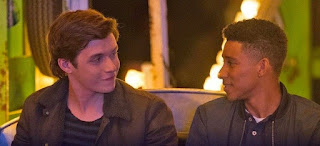
Greg Berlanti’s Love, Simon (2018)
Brief SynopsisThis film adds an interesting spin to the classic coming of age story by centering around Simon Spier, a closeted gay high school boy who struggles to find a balance between his family, friends, and secret love life. Simon finds solace by exchanging back and forth emails with an anonymous classmate who also shares this same secret. But right when he thinks all is going well in his life, Simon is threatened to be outed to everyone he loves. Throughout the film, we see Simon come to terms with his own sexuality, once he realizes that all of his friends and family still love him just the same as before he had come out.  It was the first movie to feature an LGBTQ+ protagonist, which is quite shocking. It shows the struggles a young queer person goes through and Simons coming out story, which is characteristic of a coming-of-age movie. Love, Simon was the first time that mainstream media portrayed this community through a sweet and warm-hearted story - one which young queer people can somewhat identify with and watch for years to come.


Stephen Chbosky’s Perks of Being a Wallflower (2012)

Brief Synopsis: We first see Charlie begin his freshman year of high school after being discharged from a mental health care institution. Being the shy and socially awkward person he is, Charlie initially has difficulty making any friends. However, once welcomed by two charismatic seniors - Sam and her stepbrother Patrick - Charlie’s life seems to be heading in a positive direction. Ultimately, they help him discover the joys of life through friendship, music, and love. When this trio isn’t performing in their regular Rocky Horror Picture Show, you can find them going on adventures throughout Pittsburg, discovering underground music, or attending artsy, outsider type parties. Their friendship supports Charlie as he confronts his depression and anxieties, by teaching him to embrace who he is rather than trying to repress how he really feels. I'm taking a lot of inspiration from this movie as it accurately depicts what it’s like to struggle with self-confidence issues and mental health as a young person. It's main conflict is Charlie vs. his own anxiety which is extremely relatable and the route I'm taking. The film shows how those suffering past trauma can overcome their personal battles by finding a supportive community or group of friends with whom they are able to be vulnerable and feel listened to, which is an important message for Gen Z (and other generations to come).


Other coming of age movies:

  • The Breakfast Club (1985): Arguably one of the most well-known teen films and coming-of-age films, John Hughes' movie is set one weekend where a group of teens from different backgrounds are trapped together in detention.

  • Boyz n the Hood (1991): This film was John Singleton's directorial debut, and it centered on young Black men living in Los Angeles.

  • Almost Famous (2000): Directed by Cameron Crowe, this film follows a fifteen-year-old as he tours with a rock band for Rolling Stone magazine.

  • Sisterhood of the Traveling Pants (2005): This heartwarming film, based on the book of the same name, follows four young women and best friends as they navigate family conflict, first loves, loss, and growing up.

  • Superbad (2007): The film follows two nerdy teenagers who want to party and lose their virginity before high school ends.

  • Boyhood (2014): This coming-of-age movie from filmmaker Richard Linklater was filmed over twelve years. It follows one boy from age six to eighteen.

  • Moonlight (2016): This film follows a man through three stages of his life—childhood, teenage years, and adulthood—as he slowly comes to terms with his sexuality.

  • Call Me By Your Name (2017): This Italian-set movie is a love story, following the relationship between a young man as he falls in love for the first time.

  • Lady Bird (2017): Lady Bird is Greta Gerwig's solo directorial debut. It follows a teenage girl applying for college far from home in New York and navigating a fraught relationship with her overbearing mother.


Tuesday, February 15, 2022

i blame euphoria for this

It's to no surprise that a teenager like myself would have watched the popular HBO Max show Euphoria✨, which is a pretty controversial show. But one thing I love about it is its visuals. Sometimes I ignore the plot and just admire how they use color and lighting to develop the tone of each scene and each episode, as well as developing characters and their feelings. I've been addicted (no pun intended) to the second season of the show and I put two and two together: if I need to write from what I know, then what do I know better than teenage drama and trauma? 👍 So there you have it folks, here begins my journey to create the next coming-of-age teen drama that focuses mainly on the struggles of the modern life of teenagers and how this internet-based world affects their, our, mental health. 

Scene from Euphoria: 

In this scene, the director utilizes the abundance of the color purple to express royalty, richness, and eroticism. It is developing the character as someone who is brave, powerful, wealthy, yet also erotic, even for someone who does not watch the show and does not know the character's backstory with men. 


Because I'm an incredibly curious person (sigh) I jumped straight to researching color in the creation of movies, and to my surprise came across a variety of articles in which I chose to read further into. 

"The definition of Film Color Theory is a theory that states that certain colors in film elicit certain emotions from the audience. Manipulation of these colors can be used to guide the audience toward the intent of the author, juxtaposed against one another to send a message, or subverted to create dramatic irony." -No Film School 
https://nofilmschool.com/Film-color-theory-and-color-schemes

What this quote basically means is that colors and lighting in a production can unconsciously achieve a mood for the audience, for example, if the main color in a scene is blue, it is likely that the audience will feel sad, or feel the depressive tone of the piece, and sometimes without their acknowledgment. What I seek to accomplish with this is that in my piece I want the audience to feel overwhelmed alongside the character (I wanted to do something that relates to how someone with anxiety feels) and have the scene slowly go from a depressive blue to a burning red of madness and anger. 

When telling a story, colors:

·         Elicit psychological reactions

·         Draw focus to significant details

·         Set the tone of the movie

·         Represent character traits 

.         Show changes or arcs in the story

https://www.studiobinder.com/blog/how-to-use-color-in-film-50-examples-of-movie-color-palettes/ 

As I said previously I want my piece to evoke feelings in the audience without them really understanding why, maybe they'll think they're empathizing with the character, but in reality, they'll be relating themselves with the character. Most teenagers nowadays have felt this anxiety or fear of what the world and the people on the internet think of them, and I want my piece to address that. As the lights shift from blue to red we'll also see the change of the character's mental state and emotions as they become more and more overwhelmed. 

I want to use blue as the main color for most of the opening because the character will most likely suffer from anxiety, and in this particular scene they'll be sad, anxious, scared, depressed, and just really tired, and I feel like blue paired with lowkey lighting would be the best options for the tone. 


Some examples of Color Theory being used in movies are:

In M. Night Shyamalan's movie The Sixth Sense, (picture on the right) the red-colored door is used to represent fear, dread, and foreshadowing; but in Gary Ross's Pleasantville, he uses red to represent hope, love, and sensuality. 


Now the movie, The Passion of Anna, directed by Ingmar Bergman, utilizes a change in color schemes throughout the movie to juxtapose two different sub-plots. The color red represents the passion of the relationships and the violence towards the animals.


"Bergman (or perhaps, cinematographer Sven Nykvist) establishes the emotional connotations of red in a beautifully simplistic change in color: in a sequence between Andreas and Eva the color changes from the cold blues, to hot reds, only moments after Eva kisses Andreas’ cheek for the first time." -http://www.tasteofcinema.com/2016/10-great-movies-that-use-color-to-signify-a-change-in-narrative-or-emotion/ 

I like the example of The Passion of Anna because the scenes not only utilize mise-en-scene elements with the juxtaposed colors but the overall look of the different scenes of the movie are in those colors, and that is more similar to the approach I decided to take with this project. Here's a picture as an example.


Sources: 

https://digitalsynopsis.com/design/film-movies-color-psychology/ 

https://www.studiobinder.com/blog/how-to-use-color-in-film-50-examples-of-movie-color-palettes/

https://nofilmschool.com/Film-color-theory-and-color-schemes 

http://www.tasteofcinema.com/2016/10-great-movies-that-use-color-to-signify-a-change-in-narrative-or-emotion/ 

https://www.verywellmind.com/the-color-psychology-of-purple-2795820 

Sunday, February 13, 2022

how the heck do I make a movie?

 I'm not gonna lie I'm tired of being formal and thinking about my writing too much so!!! Welcome!!! You're about to enter the insane world of a mentally ill Latina!!! No but seriously this is going to be one heck of a ride so get ready because once I start writing all my thoughts there are three things guaranteed:

1- You will go insane

2-You will regret reading this

3- You may want to be my friend and in that case hi :D 

Welcome to

THE FILM OPENING PROJECT 


There's something you should know about me and that is I am extremely creative, no I don't deny it I know I am but my god do I have the most complicated ideas to produce.
But you know what!! I'm not gonna be the only one to suffer now!! Because you're here!! Yay to you!!

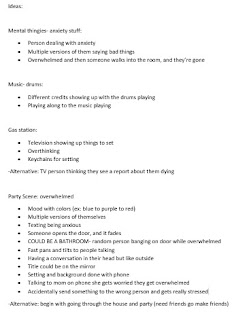
At first, my mind flowed with multiple different ideas for the project I'm not kidding I have a whole document with different ideas (proof on the right) but I kept giving up on them because they were either hard to produce (film or edit) or I just couldn't make a story with them.

A wise person once said: Write what you know.
That wise person just so happens to be Andrew Stanton, yes the guy who creates movies for Disney's Pixar ((here linked is the TED Talk that I watched about him). And so I thought "Hm, it would be smart to follow this very successful man's advice huh?"  
And so I thought about might ideas, eliminated some because, well I'm not a criminal on the run am I? ...I promise I'm not... 
ANYWHO, I decided I couldn't do this without first knowing what exactly is expected on a film opening. And so I went on https://www.tstok.net/2020-2021-portfolios  and took a look at other film openings and blogs from students of past years. I found some that I really liked and one of them had some YouTube videos that really helped. I searched up some videos myself as well and took mental notes of all the things I needed to know before developing my story. 
(Acess the videos by clicking on the highlighted words or following these links) 


What I liked about these videos is that they gave me the basics of what a film opening should have, but did not set specific rules. As the "How to Begin a Movie" video said, there aren't rules for film making, but there are guidelines, which often can be broken and can create incredible movies, but it is very risky to do so and personally I will probably follow those guidelines. Better safe than sorry!!!

Even after researching the topic, I was still having trouble with coming up with ideas that would be doable for a 17-year-old high school student with no budget or much experience at all. After much struggle, I decided to go on a call with a friend and try to get different ideas and opinions on what I should do. We developed that list more and she actually helped me so much. She said that a coming-age movie would be the easiest to produce and report to, and you can still create mystery in its opening.

We both really liked the idea of using color to set the tone of the movie, and I'm thinking about buying some LED lights for it... not really sure. I also wanted it to be set in modern times because the main goal of it would be to show the struggles of someone suffering from anxiety and other mental disorders and how they navigate in this world where everything is done online. People can be anonymous, cyberbullying exists, and everyone holds this fake image of themselves online to make others feel less-than and how that has a toll on someone's mental health. 

I've also begun thinking of the editing process. Yes I know it's a little early for that but I think it's important to think with the end in mind, meaning I can't plan for this super intricate effect-filled piece if I have no way to edit it correctly. I will probably get Adobe Premier and watch video tutorials on different editing techniques to get used to it before having to edit the actual project. 

That is all I have for now but expect multiple postings throughout this whole process because I need somewhere to share my thoughts and organize my ideas and, well, seeing as you're still reading this, you want to hear them!!! Good luck!!!
 

Tuesday, February 8, 2022

Music Marketing Project: Final


Music Marketing Project 

Part 2


Marketing means the action or business of promoting and selling products or services, including market research and advertising. It is the most important part of any sort of media-centered project and allows you to advertise and sell your product. A good marketing campaign can almost guarantee you profit and success. It is extremely important that you know the medium in which you are marketing, which means you must know the best marketing strategies for your desired project that will reach your target audience.

In this project, my group was to create a new musical artist and build their brand from the bottom up. This meant we were assigned a genre, in which ours was rap/hip-hop, and a song. We then created a music video for the song and developed our artist according to our genre. Most importantly, we had to create a marketing campaign for the artist which fit the assigned genre and successfully promote the artist into becoming famous, which was our biggest challenge. 


~Researching~


The first step of developing a brand new artist is researching the genre assigned. In our case, we got assigned rap as our genre, and so as part of our project we had to complete a music research chart. This chart required us to develop two case studies in which we would research two major record labels of our assigned genre and two artists of each, making sure to note their production, distribution, marketing, cross-media/technological converge, and synergy strategies. We decided on four major artists: SZA, Kendrick Lamar, Don Toliver, and Travis Scott. We noticed how all of these artists relied heavily on online marketing strategies such as social media. SZA interacted directly with her fans while Kendrick Lamar grew his fandom by the lack of his interaction with it. Both artists utilized the online medium in different ways, yet both were extremely successful with their approaches. Therefore, we decided that our main source of marketing should take place on social media.

(SZA and Kendrick Lamar, consecutively)

~Brainstorming/Planning~


After deciding our approach we started coming up with ideas on how to make our artists stand out from other rap artists. Would it be his music? His personality? The way he dresses? The way he talks? 
We came up with the idea of exaggerating the artist's features and personalities in a "character," one might say. This character would be sarcastic, comedic, but most importantly he would be from the '90s. With our research, we found out that rap/hip-hop was one of the top-selling genres of the 1990s and so decided that our artist's music would be '90s rap styled. He, the person, lived through the '90s and claims that he wants to bring it back, and restore the glory that rap had back then.
Now for the next part of the planning process: the music video. The song we were assigned was rather difficult to make an interesting and coherent music video to. We had many different ideas but, in practice, they were too advanced for us to produce. We wanted the music video to be somehow both comedic and express an idea that the artist was "dangerous," as that was what the song was about, but in a satirical way, since the character of the artist was known to be sarcastic. 
We decided to have the actors in the music video act like they did not take it seriously, almost in an exaggerated way of how the '90s rap music videos used to be, to bring back the nostalgia of the older millennial audience, but also interest the younger gen z audience who enjoy the comedy. 

~Production~


It was time to put our efforts and plans to the test and start producing. At this time we decided to divide and conquer: I would deal with developing the marketing campaign while the rest of the group would work on shooting and editing the music video. 


*Marketing*

As I mentioned previously, we decided to focus on social media as our main method of marketing, but that did not mean that was our only strategy. We had to create and follow the steps for our marketing campaign. First, we created the artist that I described previously and named him The Vanquisher. To build his brand, we decided to make multiple social media counts for him. All of his online presence would be marked by the same logo for recognition, and he would post, especially on Twitter, to advertise his music, but at the same time maintaining that exaggerated version of himself. On every social media account, we posted teasers, stills from the music video, and merch pictures to advertise his music and merchandise. With his posts, he would also make sure to constantly interact with his fans and followers, as well as try to connect with other artists to possibly grant himself connections in the music industry. This would help him a lot as he would gain many followers as well as have the opportunity for future content together. 

*Music Video*

Along with developing the marketing campaign we also needed to create the music video for our artist's debut song "Dangerous." As I explained, the idea for the music video would be mainly comedic. We went for the promo/storytelling approach as we thought this way we could promote the artist directly by having him sing the song but also demonstrate what the song is about with a story. Except the story would be a represented exaggeration of what the '90s music videos used to look like, therefore still keeping the artist in character with the 1990s theme and the comedy, but also bringing back a sense of nostalgia from the people who grew up watching these music videos on TV.
We looked at many different rap music videos, especially from the '90s, and choose the best types of shots and editing styles for the song. Recording days were a little chaotic, but we ended up getting around five different shots of the artist singing the entire song so that on the editing process we could choose which shots to use at each part of the song to keep it interesting and engaging for the audience. Since the music is moderately fast-paced, we matched that with our editing style. Our biggest challenge was synching the mouthing of the song lyrics to the song audio, which was done really well by our editor. He also added a black rectangle over the singer's mouth when the song contained some inappropriate language.


~Post-Production~

After getting all the footage for the music video it was time to put everything together. We let our editor, also the same person who was The Vanquisher in this case, in charge of producing the music video, while we gave input on what we thought looked the best and fit the story. Our music video was well-paced, the cuts and transitions made sense as well as the switch from storyline to shots of the artist rapping the song. Our composition could have been better, but I still believe we were able to capture the essence of the artist and the song. 
Before our presentation, we needed to divide the slides and prepare our scripts for what each person would talk about, and I kept pressing the group to do so because I wanted to be ready and prepared for the presentation, but there seemed to be a lack of motivation on their part. It was confusing up until the day of the presentation who would talk about which slide, and I was getting stressed over it. 


~Presentation~

Watching some of the other presentations made me realize ours was very well done. We explained our marketing campaign, artist, discussed our case studies, elaborated on how the music video represents the artist and the song, and more. We did so consistently, and even though at some point there was some confusion on who would talk about which slide, we recovered from it quickly and the presenter did a good job on her explanation. The slides were '90s themed and matched the genre and artist well. When questions surfaced, we answered them truthfully and with solid resources. Overall the project could have had been better and could use a little more work, but it was still well-made. 


~Resolution~

With this project, I learned many things that will help me throughout my professional life and career. Hard work is worth it and can open a world of possibilities you couldn't imagine possible. I never thought I would be creating my own artist and marketing campaigns one day, but dedicating myself to this project has taught me important skills. I realized how crucial to any media the process of marketing is, and how a good marketing campaign can make an artist go from unnoticeable to successful very quickly. It showed me how connecting with other artists and collaborating with successful and known companies can expand your following and is key to long-lasting fame and recognition. When developing my Cambridge portfolio I will be sure to pick a good partner that is as dedicated as I am and listens to my ideas as much as I listen to theirs. I will all the steps used in this project--researching, planning, producing, post-producing, presenting-- to my advantage in hopes of developing Cambridge-worth material. 

Wednesday, January 26, 2022

Music Marketing Project: Researching and Planning


Music Marketing Project 

Part 1


Marketing means the action or business of promoting and selling products or services, including market research and advertising. It is the most important part of any sort of media-centered project and allows you to advertise and sell your product. A good marketing campaign can almost guarantee you profit and success. It is extremely important that you know the medium in which you are marketing, which means you must know the best marketing strategies for your desired project that will reach your target audience.

In this project, my group was to create a new musical artist and build their brand from the bottom up. This meant we were assigned a genre, in which ours was rap/hip-hop, and a song. We then created a music video for the song and developed our artist according to our genre. Most importantly, we had to create a marketing campaign for the artist which fit the assigned genre and successfully promote the artist into becoming famous, which was our biggest challenge. 


~The song~

The song we got assigned is called Dangerous by the rapper Busta Rhymes, released in 1997. The first challenge we faced was the fact that the singer of this song is African American, and the song contains African American slang that is considered a slur for people outside that community. We had to make a decision whether we wanted to bleep out the words in the song or leave them but not film our singer lip-synching those words. At last, we decided to remove those words from the original track in the editing process.                                                                                                                                        Busta Rhymes- Dangerous (1997)       


~The Character~

After researching the song as well as its original music video, we came up with the idea of creating a character for the artist. A fake persona that would have comedic characteristics, catchphrases, strong online presence, and he would embrace the '90s culture. The character's story is that his personality, clothing style, and lifestyle got stuck in the '90s and he has a strong passion for it. His goal is to bring back the culture of that time and the artistic music style especially rap since it was a best-selling genre in the 1990s. We decided his persona should be comedic, as the target audience for his music is millennials and older gen z, they have a stronger sense of humor and value comedy over the quality of a product (research shows they prefer to be easily entertained than consume quality content). 

Meet our artist: The Vanquisher.


~Online Presence~

Researching rappers and hip-hop artists nowadays showed that they heavily prioritize online marketing and advertising through social media. We created various accounts (Twitter, Tiktok, YouTube, Instagram) where our artist will directly interact with his fanbase, create a following, connect with other artists building relationships where they can have a collaboration in the future, and advertise all their content. We discovered that rappers like to release teasers or demo versions of songs on their social media to attract the public and see how successful the song would be if they fully produced and released it, many times resulting in the fans pleading with the artist to release the song as soon as possible. 
We also plan to create a website for our artist where we will post all merchandise, tickets for q&a sessions as well as meet-and-greet and concert/shows. In addition, our artist will be known for hosting secret pop-up shows where he will release the concert information in a few hours/days before the show, and especially at the start, he will sometimes not share the information at all. Moreover, all his music will be distributed on online platforms such as Spotify, iTunes, Apple Music, and SoundCloud, but he will also sell CDs of his songs and albums on his website alongside his merchandise.


~Music Video~

The last step for the researching/planning part of this project is planning and mapping out our music video. We looked at many different rap music videos, especially from the '90s, and choose the best types of shots and editing styles for the song. We are doing a promo-storytelling piece, which means we will have parts of a story happening at the same time our main artist will be singing the song, promoting himself. Since the music is moderately fast-paced, we will match that with our editing style, and we have created a storyboard as well as a list of shot ideas for the music video. As you can see in the picture, rap videos from that time used to have a variety of different shots, but some significant ones are the close up of the mouth rapping, the low angle of the rapper in a "cool" position over the camera demonstrating power, and the crossing of arms. Additionally, we will implement short snippets of the music video in all of The Vanquisher's social media to promote it. Our biggest challenge when making the video will be matching up the lyrics with the singing shots, which is why we recorded the whole song over multiple different angles shots and compositions and then we can pick which shot would look smoother for the lip-synching. 


Here is a visual of what our marketing planning looks like currently, and if we succeed then be ready to have The Vanquisher as your new favorite artist!

it was the end of a decade... but the start of an age

 LONG LIVE THE WALLS WE CRASHED THROUGH 😭😭 why have I started the last two blog posts with a song... I'm clearly not mentally stable.....